Celebrating Cinema

Celebrating Cinema
Showing posts with label Clint Mansell. Show all posts

Monday, June 27, 2011

Black Swan (2010)

by Darren Aronofsky


An Analysis

"I had the craziest dream last night." Black Swan expresses and examines the physical, psychological, familial, and sexual pressures on a ballerina, Nina Sayers (Natalie Portman), who has been chosen as a prestigious New York City ballet company's featured performer in this season's re-imagined production of Tchaikovsky's Swan Lake. To become the Swan Queen, Nina must exude the delicate purity of the White Swan then ascend as the Black Swan by corralling and evincing her dormant aggression and libido. In his fifth film, Darren Aronofsky's directs his second consecutive Best Acting nominated performance (Natalie Portman, Mickey Rourke). Black Swan follows Aronofsky's Pi (1998), Requiem for a Dream (2000), The Fountain (2006), and The Wrestler (2008).


<<<  SPOILERS BELOW  >>>

Please see the film before reading further

Aronofsky-as-Auteur

Clint Mansell
Aronofsky welcomes several of his regulars to his fifth film, including good luck charm, actor Mark Margolis (albeit as a scene-cut extra, he's in his 5th film with Aronofsky), director of photography Matthew Libatique (4th film), producer Scott Franklin (4th), actor Stanley Herman (3rd, who amusingly reprises his role as subway weirdo "Uncle Hank"), and parents Abraham and Charlotte Aronofsky (5th and 3rd, respectively).  Perhaps most important is Clint Mansell, who scores his fifth Aronofsky film. Though Mansell maintains some chords and progressions heard in Requiem, he re-writes Tchaikovsky in a new, dark mood.  

After a respite in The Wrestler, Aronofsky revisits his method of fusing real, in-film action with one character's fantasies, dreams, and paranoid delusions--in this film, they belong to Nina. Viewers cognizant of Pi will be prepared to handle another experiencing of this technique, and will be better able to perceive Nina's feelings and demons. None of his films are so terribly confusing as The Fountain, but newcomers to Aronofsky need a bit of prior warning or post-viewing guidance for Black Swan.

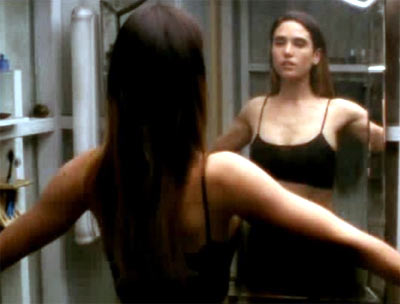
Requiem (above), Black Swan (below)
Though there is great stress between Nina and her mother Erica (Barbara Hershey), Aronofsky chose not use the same techniques that portrayed the Requiem relationship between Sara and Harry. No split screens, and no 180-degree camera swings.   


Nina's grapefruit breakfast reminds us of Sara Goldfarb's eggs-and-grapefruit diet in Requiem. We know what price Sara paid for such food controls. The fall-out of Nina's stricter diet is tempered by Nina's greater purpose, physical activity, and a hope for something achievable and earned, as opposed to Sara's TV appearance wish, which can only be bestowed.

Aronofsky's camera techniques create much of the film's mood. Aronofsky rightly uses the camera to present a very unsettled, confidence-lacking, on-the-brink-of-breakdown, paranoid Nina. Aronofsky also uses a steadicam that revolves around Nina when dancing, creating a visual maelstrom. 


The Camera "Following" Nina
Aronofsky continues his "following" technique he developed in The Wrestler. As we experienced Ram's point of view, most interestingly navigating the backstage corridors of boisterous arenas, we get a remarkably similar experience with Nina's navigating Lincoln Center's cinder-block underbelly.


One of Aronofsky's smartest habits is teaching us about worlds unfamiliar to most of us. He has taken us behind the scenes of professional wrestling, shown us mathematics, and taught us specifics of heroin addiction. In Black Swan he shows us the the little things that all dancers know but the rest of us do not. For instance, he shows us three scenes of Nina preparing ballet shoes--the first a montage of breaking down, scoring, and re-sewing them, the second a scene of Nina and Erica scorching ballet shoe ribbons, and the third a shot of Nina grinding her ballet shoes into a sand/glass mixture. These little teaching moments make us feel a part of Nina's world, and help us connect to Nina.

Last Aronofsky returns to his fade-to-white technique used in Pi and Requiem. Upon Nina's ascendancy as the unfettered Black Swan, Aronofsky ends the film with a fade to white to indicate, not a blinded-by-the-sun moment, but a more transcendent, triumphant moment. She has overcome adversity and demons, and has unlocked long-repressed personal and sexual strengths. She, like the Swan Queen, may have also killed herself.

Nina's Adversity

Erica, Feeding Her Daughter Icing
From the film's beginning, Nina's timidity seems incongruent with both her talent and success. She has thrived as a delicate, waif-like ballerina whose skills and prominence are only surpassed by an about-to-be-retired 40-something, Beth Macintyre (Winona Ryder). Like Beth, Nina in her new, headlining role soon feels the All About Eve (1950) footsteps of her nearest challenger, Lily (Mila Kunis). Nina also faces the physical pain of being a featured ballerina:  bleeding feet, split toenails, joints relieved by the painful pulling of a physical therapist. Nina still lives with her controlling, daughter-focused, helicopter mother, Erica, an unaccomplished dancer who retired at 28 to birth and raise Nina. Erica now makes paintings of Nina, sleeps in a chair in Nina's room, runs Nina's schedule, calls Nina several times a day, and, perhaps most controlling, undresses Nina to her panties. Erica has kept Nina from having friends. Maddeningly, to celebrate Nina's landing of the Swan Queen role, Erica forces cake on Nina, something very much out of Nina's Erica-monitored nutrition regimen. Last, and perhaps most important, though Nina has landed the role, she fails to convince the director, and herself, of her ability to succeed in the Black Swan half of the role.


The story's construction provides much of the film's brilliance. Early, Nina's primary source of conflict is with her mother. Next we see her start down a path to loosen up, to become independent and an adult. Both conflicts obscure her underlying psychiatric disorder(s). The delay and ambiguity in revealing the disorder(s) probably creates a great deal of strife for viewers who are impatient, new to Aronofsky, or new to any sort of avant-garde cinema. I do not suggest that Aronofsky not stick to his creative guns. Films like this create the opportunity in new audiences for reflection, multiple viewings, and exploration into a director's catalog.   


We desperately want Nina to succeed, to break away from her mother, and to become a sexy, confident woman and dancer. Tragically they converge alongside her peaking psychosis.


Not being a mental health professional, nor a dancing expert, nor familiar with Swan Lake, I shall mostly leave alone those realms in this analysis.


Thomas


Thomas and Nina
Thomas, the French director of Nina's ballet company, is a womanizing, smug, ass who produces great performances. A swan skeleton decorates his office while vaginally-themed art dominates his flat. When we first meet Thomas, he appears silently, standing in the rehearsal space's stadium seating. The dancers immediately disrobe, to a certain extent. We now know his power, and what he expects of dancers, both on and away from the dance floor. He quickly, though incredulously, pegs Nina as a virgin. Both Thomas and Lily, multiple times, tell Nina to loosen up. Thomas instructs Nina, "Go home and touch yourself." Nina allows herself such pleasure when she wakes in the morning in her bedroom, that is, until she notices her mother in the bedroom chair. When Nina eventually succeeds, Thomas transfers his paternalistic nickname for Beth onto Nina, "My Little Princess."


Nina's Hallucinations


Within the context of Black Swan, Nina's hallucinations demand attention and explanation. Two hallucinations deserve the most focus because they confuse, and because understanding them is essential to understanding reality within the film. When Nina and Lily are first introduced, Lily foreshadows, "Are you freaking out? I've been losing my mind."


Nina Hallucinating a Night with Lily
Nina's night out with Lily happened pretty much as shown... until, when Nina's is walking out of the club, Lily sticks her head out the exit door and calls after her. Lily calling after Nina outside the club is the first moment shown that night that never happened. The cab ride seduction never happened because Lily was never in the cab--it was Nina's fantasy. Lily spent that night with Tom, the dolt she met at the club; therefore, she could not have been in the cab. A second viewing of the club dancing scene shows not just Nina's physical comfort with Lily, but it also shows them eventually becoming virtually indistinguishable from one another on the dance floor, a bit of visual foreshadowing that helps us explain Nina's hallucination. Lily's actions in the apartment, particularly the mouthing of Nina's words as Nina speaks them (see Fight Club (1999)), reinforce that Lily was never inside the apartment. Through the hallucination, Nina progresses toward becoming more sexual and more independent, but, sadly, her psychosis is becoming more manifest.


Second is the broken mirror episode during the opening night performance. We see Nina attack Lily, stabbing her with a mirror shard. But, like all the previous times when Nina thought Lily was there yet saw a flash of herself (Nina's self) in Lily's place, we know that Lily once again is not really there. Nina of course has stabbed herself instead, and I believe it to be the work of her psychosis. 


Nina's Psychosis
There are other hallucinations one can misunderstand without compromising one's understanding of the film. Nina's cuticle mangling of course never happened--Aronofsky was kind enough to show us the reality, to let us in early on her penchant for hallucination. The woman who appears twice, once over Nina's bathtub and once in a corner of Nina's apartment... I have no idea who that is. My best guess is that she is Nina's mother, Erica, at the age when Erica retired to give birth to Nina. Nina seeing Lily and Thomas having sex off-stage was Nina's paranoid delusion. Nina's several mirror hallucinations suggests that Nina probably has some sort of dissociative or schizophrenic disorder. Last, and remarkably unimportant, is the final scene involving Beth and Nina. Though we see Beth self-mutilate, we also see Nina drop the bloody weapon as she flees into the hospital's elevator. It seems odd that Nina would not be tracked down by police before the end of the opening night performance, but I am willing to allow that such investigations take more time. More important, not only do I believe Nina stabbed Beth, it is also at this point in the film that I first suspected that Nina pushed Beth into traffic, causing her hospitalization in the first place. That last tantalizing question may be unanswerable, but it is worthy of a good smoke.   


Leitmotifs


Though not in the strict musical sense, Aronofsky's mise-en-scène uses leitmotifs of color to convey Nina's descent into psychosis, into sexuality, into the Black Swan. One is tempted to cry "cliché!" if not "racism!" with the white equals good, black equals bad formula, but Aronofsky can be excused easily, for the color palette set forth by Tchaikovsky's ballet is rather unavoidable. The embodiment of sexual confidence, Lily is always shown in black.  Nina is mostly in white or other light colors (including a very light-colored pink overcoat). Nina's first appearance in grey happens in Nina's first rehearsal in which she makes an attempt to liberate her sexuality, resulting in Thomas's funny in-joke, asking Natalie Portman's husband, "Would you fuck this girl?" 

Nina first dresses in black at the dance club, appropriately in a naughty little number supplied by Lily, which, along with similar hair, allows them to become indistinguishable on the dance floor. Indeed, during the club dancing scene we get a flash of Nina in her Black Swan makeup--her transformation has begun. Later, in the cab ride hallucination, we also notice Nina's black pants, perfect for her first sexual touching by someone else. We ultimately see her in her fully-clad black glory in opening night's second act as the Black Swan.


Lily, Hair Down
Hair also plays an important role in shaping our understanding of what Nina is feeling. We first notice a difference in hair when Nina sees Lily rehearsing with her hair down, something atypical among dancers thus far in the film. The night that Lily comes to take Nina out partying, we see Nina with her hair down already. She is ready to go. As mentioned above, the hair, along with the matching black outfits, allow Nina and Lily to become indistinguishable on the club's dance floor--Nina has absorbed Lily's level of sexuality. The symbolism of literally letting one's hair down may be too obvious, but it bloody works. Who among us was not immediately drawn to the hair-down dancing of Lily in that rehearsal?


Conclusion


Nina, Perfect
Nina's triumph is the peaking of her talent, her sexuality, and of her psychosis. Thomas asks as she lies bleeding, "What did you do?!" Nina responds, mostly to herself, "I felt it. I was perfect." I do not remember a film with so tragic a triumph. Even The Wrestler's Randy "The Ram" Robinson was tragic, but ended without triumph. Denouements with the simultaneous feelings of regret and success tend to be found in war movies. I welcome suggestions of films with similar endings.


Aronofsky continues to make challenging, brilliant films.  Here is to hoping his productivity moves toward Woody Allen's and away from Terrence Malick's (or at least the Malick of old), while continuing with the same level of innovation and creativity he has always given his grateful audiences.


Trailer to Black Swan (2010)

Tuesday, January 11, 2011

Requiem for a Dream (2000)

by Darren Aronofsky


An Analysis

Sara Goldfarb and son Harry

Requiem for a Dream, Darren Aronofsky's direction of Hubert Selby, Jr.'s novel, interprets the distinct spirals into addiction of four Coney Islanders--Harry Goldfarb (Jared Leto) and the three closest people in his life: his mother Sara Goldfard (Ellen Burstyn); his best friend Tyrone "Ty" C. Love (Marlon Wayans), and his girlfriend Marion Silver (Jennifer Connelly). Harry, whose life is going nowhere, aside from having a sultry girlfriend, occasionally steals his mother's television for pawning. Sara Goldfarb's life is without purpose and has little hope.  Financial support from Marion's parents is waning while Marion's fashion design career has yet to launch. Ty fantasizes about making his long-gone mother proud. Like Harry, Ty has done nothing with his life but land one of the hottest-bodied young women around, Alice (Aliya Campbell).


A requiem is music and ceremony for catholic funeral masses. This Requiem for a Dream is indeed a funeral service for its characters' hopes and dreams, and only we are in attendance.  


Harry and Marion cuddle
Requiem for a Dream's storytelling is driven by Aronofsky's cinematic leitmotifs -- styles that signify similar themes, places, or characters when seen or heard. Unlike in The Empire Strikes Back, where each musical style refers to a character (e.g. Darth Vader and his "Imperial March") Requiem's leitmotifs, both visual and auralsignify similar narrative themes and feelings within and among characters.


<<<  SPOILERS BELOW  >>>

Please see the film before reading further


Addiction


Each character endures one or more addictions. Sara has an addiction to TV, then to her newfound popularity among the gaggle of old women in the building, then to fitting into her red dress, and finally to her weight-loss pills, 3/4 of which are uppers. As an abandoned widow, she is the most vulnerable of the four.


Harry and Ty, hocking Sara's TV.
Harry is addicted to making his girlfriend happy. To make Marion's dreams come true, and to supply his "TV junkie" mother with a fix (a new TV, "from Macy's!"), Harry deals drugs on the street. Harry, already a heroin user, also becomes addicted to heroin, which literally costs him an arm, if not yet a leg.

Although Ty is a heroin user and dealer, the drug is not his downfall.  Ty's inner pressure to please his  fantastic mother becomes his addiction.  

Arnold with Marion
Marion, a heroin user, has lost financial support of her parents, due to reports from her unethical analyst, Arnold (Sean Gullette). Her dream of opening a storefront for her clothing designs pressures Harry into dealing drugs. Her newly-regular access to heroin becomes her second, more powerful addiction. Marion soon takes to being a prostitute-for-drugs to wealthy Big Tim (Keith David), and then as a hired pornographic party girl who finds herself in a double-dildo anal display, surrounded by engorged suits and fellow nude party girls. Fallen from her dreams as a clothing designer, she ends the film naked.  


Aronofsky-as-Auteur


Aronofsky, just two films into his career, has developed techniques and patterns as an auteur. He is loyal to cast and crew, returning many from Pi (2008).  Requiem's visual style is recognizably from the loins of Pi. And Aronofsky's fascination with hallucination and fantasy scenes continues.

Strung-out Sara Goldfarb shot with fisheye lens
Requiem's expressive visual feast betrays Aronofsky as its director; with a style similar to his debut Pi, but far more advanced, as Requiem has its own visual language. Aronofsky returns to the All That Jazz-like heroin-injection and pill-popping sequences from Pi. Requiem uses, as does Pi, a fish-eye lens. In Requiem it is used twice, first during Sara's experience of the lurching refrigerator, then in her next scene, a time-warped second visit to the diet doctor's office. Aronofsky has his actors, and one prop, wear the camera, including once in a Pi-like chase sequence, a technique used in John Frankenheimer's masterpiece Seconds (1966). Last, five times the screen fades to white.
  1. After Harry and Marion's split-screen love session, the screen fades to white.  
  2. Marion, bottom-nude before a mirror, is sad, injects heroin, then feels the euphoria of a heroin high as the screen fades to white.
  3. After Sara and the gaggle mail her TV application, the screen fades to white.  
  4. After Ty returns with the heroin score, he and Harry get high together.  Their euphoria fades to white.
  5. Harry's arm is sawed off, then the screen fades to white and into his Marion-on-the-pier fantasy.
These fades-to-white are probably a reference to Pi, in which a fade-to-white is a metaphor for Max staring at the sun, by which he metaphorically blinds himself. Perhaps Sara, putting her dream into one white envelope, and the three young adults who turn to heroin or each other for their happiness, are staring into the sun, blinding themselves to the world.


Mr. Rabinowitz
Aronofsky has Pi's primary cast return in Requiem for a Dream, albeit in briefer roles.  Mark Margolis (the mentor) is Mr. Rabinowitz, the pawnbroker (named after the film's editor); Sean Gullette (Max) is Marion's ex-sugar daddy Arnold; and Ben Shenkman (Lenny Meyer) is Dr. Spencer, who tends to Sara toward movie's end.  Requiem also returns much of Pi's supporting cast, including Samia Shoihib (Devi, the young woman next door) as Sara's diet nurse; Ajay Naidu (Farouk) as the mailman; and Joanna Gordon who reprises her role as the landlady, Mrs. Ovadia. Pi's original music composer, Clint Mansell, triumphantly returns for Requiem.  

Last, Aronosky seems to establish a trend of not trusting religion. In Pi, the Hassidic Jews were one of the two villainous groups. Requiem features an unseen drug connection named "Angel," who time and again provides the materials or information for Ty, Harry, and Marion to bring harm to themselves.


Leitmotifs

Aronofsky uses visual and aural phrasing, or leitmotifs, to emphasize relationships, to show fantasies, daydreams, & hallucinations, and to draw parallels between characters' emotions that each experiences at different times in the film, or to draw connections among characters at the same time in the film.

Aronofsky illustrates connectedness and relationships via several visual phrasings. Seen six times in the film, the split screen brings the two subjects in each half of the screen, already close, closer together, often illustrating a dependent, co-dependent, or enabling relationship.  

Split-screen: Sara's dependence on diet pills
  1. The first split screen occurs early. Sara locks herself in a closet while Harry demands the key for the locked-up TV that he is about to pawn. We later understand their co-dependent relationship as Sara, ever lonely, always buys back her TV from boardwalk pawn broker, Mr. Rabinowitz.  
  2. The second split screen shows Harry and Marion in bed in a creative and sensual scenes of caressing.  Though the scene is beautiful, we shall soon see that the relationship is codependent.  
  3. We also see Sara split-screened with the fridge--she craves the food inside.  
  4. Harry and Tyrone shoot up together, split screened and side-by-side on the couch. About to go into heroin-dealing together, they are co-dependent.  
  5. We later see Sara, who has abandoned the egg-and-grapefruit diet, split-screened first with her new diet pills, and then with her cream cheese roll--a sort of saying hello to the former and a goodbye to the latter.
  6. We do not see another split-screening until the very end, when Ty, curling up into the fetal position, is split-screened with his mother of years past. It is not a true split screen--it's two separate semi-transparent shots, but it looks like a split-screen.

As mentioned earlier, Aronofsky has three of the characters, and Sara's original TV, each wear the camera once. Aronofsky was forced to cut the scene he shot of Harry wearing the camera.
Marion, returning from sex with Arnold
  1. The TV wears the camera early, to show the faces of Harry and Ty, who are about to pawn it for heroin.
  2. After the hit on Ty's drug lord in the limo, Ty runs down an alley wearing the camera, face splattered with blood.  This technique keeps us focused on his terror-covered face as the rest of the world jerks about behind him.  
  3. As Marion returns from having $2,000 sex with Arnold, her corrupt therapist, and after we have watched Harry squirm and shoot up from the emotional pain of the Arnold situation, Marion, terrified of what this says about her and what it means to their relationship, wears the camera down the hallway and into the elevator. In the elevator she briefly wears the camera on her back, showing the doors closing in front of her, and showing us how small she feels.
  4. When Sara takes a personal-best four pills at once, and the fridge comes alive, bolting at her, Sara is wearing the camera, enhancing our sense of Sara's surreal experience of terror.

Twice Aronofsky uses an overhead, rotating camera, pointed straight down to connote romance, that the two lovers have enveloped each other. It also marks the last time the two involved in the scene are shown in love.
Marion and Harry high, together
  1. The rotating, "ceiling fan" camera is first used when showing Ty and Alice nude in bed, caressing. We never see Alice again.
  2. The last scene before Harry and Marion's first argument, we see their heads ear-to-ear, bodies opposed 180 degrees. They are high, but muster love. 
Introducing Marion Silver
Aronofsky's use of muted colors almost makes Requiem his second black-and-white film. His rare use of vibrant color often depicts a character's hope or dream. Marion is introduced to us wearing Yale blue, looking to the sky, shot against an Irish-green lawn. In cinema, looking up to a blue sky often represents hope for one's dreams. Not much later, muddling about a muted green and taupe apartment, Sara Goldfarb pulls out a bold red dress, signifying her television dream. Last, during Ty's daydream of his child self, running to his mother's arms, his mother is wearing a vibrant white-and-blue muumuu. She is his literal dream.


Sara, lost, with the world at high speed.
Sara an Ty share a leitmotif that shows them at low, helpless, confused times. When thrown in jail then prison, Ty's face is pressed between bars. His eyes wander, considering his place, as his cell-mates mull behind at a great, time-elapsed speed. Similarly, having popped her last ineffective pills, Sara stumbles the streets, grasping as pedestrians pass her at the same high speeds as Ty's cell-mates. 


Sara, after Electroconvulsive Therapy
The film ends with all four characters curling into the fetal position, one after the other, each alone.  Harry curls after he wakes to realize his arm's fate. Marion, back from her humiliating escapade, withdraws a sizable bag of heroin from her pants, then curls, pressing the bag to her chest with both hands, where Harry once was. Ty, in prison, missing his mother, curls up, and we see the aforementioned split screen with his mother of years ago. Sara, in the hospital, hair lopped off, and exhausted from ECT (Electroconvulsive Therapy), curls up as well.  Each wants to be safe.


Harry and Marion, suddenly distant
Twice character spacing is used to connote distance in a relationship.  First, Harry's second scene with his mother shows a personal, uncomfortable distance between them, regardless of their hug. Later, after Marion has had sex with Arnold, she returns.  They sit on opposite sides of the couch.  Their bond has broken.


Ty and Harry playing Keep Away with a cop's gun
Aronofsky uses "If-only-I-could" fantasy scenes, much like we saw the previous year in Doug Liman's Go (1999) and would see in Stephen FrearsHigh Fidelity (2000). We see it twice, first when Harry steals the cop's gun and, with Ty, plays Keep Away. Did Aronofsky or Selby know that the game is sometimes called Piggy in the Middle? We next see this technique used in Marion's second dinner with Arnold, wishing she could stab a fork through his hand.

Daydream with Marion
Requiem also features pleasant daydreams. Harry dreams of running to Marion at the end of Coney Island's pier. Ty daydreams of childhood times with his mother.

Requiem displays hallucinations beyond camera effects, and they all belong to Sara and her food battles.  She sees through the fridge's door so as to view the food inside. After that, she attempts to sleep, only to imagine cupcakes and bagels flying at her.  Later the fridge lurches at her, demanding attention. It later roars as it turns into a giant mouth. Last, of course, the entire apartment merges with the TV show.  Addiction to wanting to be on TV, weight loss, and speed conspire to make Sara's life distressed as never before.


Marion, all better after shooting up
The theme that speaks to the relief heroin provides is shared by Marion and then Harry. Marion's experience is mentioned above, in the sequence that fades-to-white: Marion is forlorn, injects heroin, then feels euphoric.  Later, after Harry and and his mom have had their difficult second scene, Harry leaves in a cab, shaken and upset. He injects heroin in the cab, and we see him feeling that all is better.

Last among the leitmotifs is Clint Mansell's Kronos Quartet-assisted score. The first scene between Sara and Harry has sounds of an orchestra warming and tuning for a performance--we are about to experience a requiem. Aronofsky returns several times to Mansell's marching-to-the-underworld, strings-heavy theme that follows the orchestral warm-up. It is vital to the film's feel of anxious, imminent, unavoidable doom. That theme, after being introduced early, does not enter again until Sara and the gaggle mail the TV application--a seminal moment in her downfall. After much time away from it, the theme is thrust into Ty's running-from-the-limo scene. It is next heard during the aforementioned sequence of Marion returning from Arnold, Sara applying lipstick, and Ty missing his mother. It last is heard starting with Ty's return to the workhouse locker room, carrying through the end of the film and its credits.


Connection Sara and Harry


Though they live blocks apart, Harry and his mother Sara share only three scenes, and keeping them connected throughout the film is necessary for us to understand why both are in the picture.  For instance, so much in-film time elapses between Harry's visits--an entire summer--that we are surprised when Harry does not know about his mother's forthcoming TV appearance.  

Of course, scenes often alternate from Sara's scenes to Harry's scenes, and increase in frequency as the end approaches, but other techniques are used.  Not long after Harry decides to buy his mother a new TV, Harry and Marion's heroin shoot-up montage morphs into a montage of Sara's pill-popping. Later, the score, whether the strings theme or the rave-like theme, plays without break over several sequences of scenes. One example begins with Marion's return from Arnold's, to Sara's bad-lipstick application, then to Ty, clutching a picture frame, missing his mother. All three editing techniques serve to keep Sara and Harry connected.

Harry and Sara's final scene is the film's last.  Harry is able to rejoin his mother, if only in her TV dream--"I love you too, ma." This is her fetal-curled fantasy. The show was only ever in her head, and only she would dream of announcing Harry as about to be married, something she pushed in their second scene. She knows not of Harry's spiral. Of course, given that the reconciliation happens within the TV show, we question ECT's effectiveness. Sara somehow finds a bit of hope to grasp, but to what will she grasp when she learns Harry's fate?


Since Requiem for a Dream...

With a Hollywood-scale budget, Requiem is Aronofsky's first venture beyond low-budget films. While casting Academy Award winner Burstyn, rising stars Connelly and Leto, and comedic actor Wayans in his first dramatic part, Aronofsky has confronted the challenge of higher expectations. Requiem's impact on its actors has been substantial. Burstyn received her sixth Academy Award nomination for her difficult exploration as Sara Goldfarb, while Connelly used her success in Requiem to ascend to an Academy-Award winning role in A Beautiful Mind (2001) and is a consistent contender for the cinema's best female roles. Wayans has squandered his Black Reel-nominated performance  on a career of terrible comedies. And Leto has averaged one film per year since, choosing to concentrate on his band 30 Seconds to Mars and its three post-Requiem albums. Aronofsky has since made three more films, including Black Swan (2010), which many critics predict will earn a Best Picture Oscar nomination.
  
Each time one watches Requiem for a Dream, one sees something new and ingenious. Introduce it to your friends, and don't let any of them, or yourself, get away with saying of it the clichéd "it's depressing." There is too much cinematic mastery to behold for viewers to settle on such labels. 

Requiem for a Dream trailer